
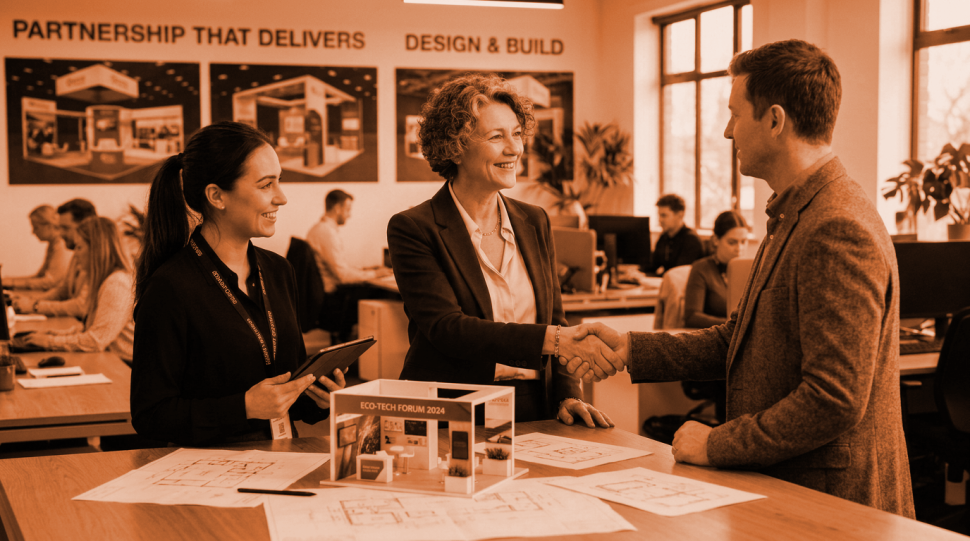
Nineteen years. That’s how long I’ve spent designing exhibition stands and brand activations for companies across every sector you can imagine – from scrappy start-ups launching their first product to household names defending their patch at the biggest shows in their industry. Nineteen years of driving footfall, sparking conversations, building community, and putting brand awareness on steroids for a few frantic days on a show floor.
By any sensible definition, that makes me a marketeer.
And yet, if you asked me at a party what I do, I’d never say it. I’d tell you I’m a 3D designer. These days, a director of exhibition and brand activation, design and build. It’s a mouthful – genuinely, I should find a way to say it in one word – but “marketeer” has just never been part of my vocabulary, even though marketing is, without question, the discipline I’ve spent my entire career serving.
I think that says something interesting, not just about me, but about the strange, slightly overlooked corner of the marketing world I operate in.
The bit of marketing that doesn’t feel like marketing
Most marketeers I work with have built their careers inside funnels. Digital campaigns, content calendars, paid media, brand tracking, lead scoring – the language of modern marketing is largely built around measurable, repeatable, always-on activity. It’s a world of dashboards and attribution models.
Then, once a year (sometimes more, if they’re unlucky or brilliant, depending on how you look at it), that same marketeer has to step out of the funnel entirely and into a completely different discipline: physical space. Suddenly they’re not thinking about click-through rates, they’re thinking about floor plans. Not A/B testing subject lines, but choosing carpet colours. Not optimising a landing page, but working out how to get people to actually walk into a 6m x 6m stand and stay there.
It’s a genuinely different skill set. And it’s one that most “Head of Marketing” job descriptions never really prepare anyone for.
That’s the gap I’ve lived in for nineteen years. Not quite marketing in the traditional sense. Not quite construction or interior design either. Somewhere in the middle – translating brand strategy into a physical, three-dimensional experience that has to work in real time, in front of real people, with zero opportunity for a re-run.
Why the expo creeps up like a rabbit in headlights
If you’re a marketing manager reading this with a trade show already circled in red on next year’s calendar, I’d hazard a guess you already know that slightly sick feeling.
It’s not usually the big creative decisions that cause the anxiety – most marketeers actually love that part, coming up with a concept, thinking about how the brand should look and feel in a room. It’s everything else that sits underneath it:
Booking the right space, at the right size, in the right spot on the floor plan, often months (sometimes a year or more) before the show even opens its doors. Setting a budget that has to somehow cover design, build, logistics, staffing, travel, and the inevitable “just one more thing” that always creeps in. Writing a brief detailed enough that whoever designs the stand actually understands the vision in your head – not as easy a task as it sounds, especially if you’re not naturally a visual thinker. And then there’s the paperwork. Health and safety documentation, venue compliance, insurance, method statements – the unglamorous admin that nobody puts in the “marketing” part of their job title, but that absolutely determines whether your stand gets built on time or gets stopped at the door.
All of that sits on top of a budget that’s usually one of the biggest single spends in the marketing calendar for the year. No wonder it can feel vulnerable. If a paid campaign underperforms, you optimise it and try again next week. If your stand doesn’t turn up looking the way you pictured it, you’re standing in front of your entire industry, for three days, with nowhere to hide.
The single decision that changes everything
Here’s the thing I’d want every marketing manager to know before they even get to the brief-writing stage: the partner you choose to design and build your stand matters more than almost any other decision in the process.
Not because of pricing (although obviously that matters). Not even because of portfolio, although a strong one absolutely gives you confidence. It matters because of what happens after you sign off the concept – the months of back-and-forth, amends, supplier coordination, and problem-solving that happen largely out of your view.
You can actually get a real sense of what that relationship is going to be like right at the very start, at the design stage, long before any contract is signed. Pay attention to:
How they communicate. Are they clear? Do they explain their thinking, or just hand you a render and hope you like it? Do they ask good questions about your brand and your goals, or just about your budget?
Their lead times. Anyone can promise a fast turnaround when they’re trying to win the work. What matters is whether their proposed timeline is realistic given everything else that has to happen – fabrication, logistics, installation, contingency for the inevitable curveball.
Their response time. This is the one people underestimate the most. If a studio takes four days to answer a simple question during the courtship phase of a project, what’s going to happen three weeks before the show, when you actually need an answer within the hour?
Those three things – communication, honesty about timelines, and responsiveness – tell you almost everything you need to know about what working together is actually going to feel like. Far more than a slick pitch deck ever will.
Get that right, and something quite lovely happens: the whole project should become a breeze. Amends get handled without drama. Communication flows both ways. Expectations, set clearly from both sides at the start, are met. You, the marketing manager, get to go back to running your actual day job – the campaigns, the content, the budget lines you’re used to – while the expo build carries on quietly and competently in the background.
That’s not a nice-to-have. That’s the entire point of hiring a design and build partner in the first place. If you’re still fielding daily fires about your stand three weeks before the show, something’s already gone wrong further up the chain.
What it should feel like on day one
I always think the real test of a good exhibition partner isn’t the pitch, the render, or even the build itself. It’s the moment a marketing manager walks onto the show floor on the morning of day one.
At that point, there should be no surprises left. The stand should look like the visuals you signed off on months earlier – not a rough approximation of them, not “close enough,” but actually matching what you were shown and sold on. The finish should be genuinely top notch: no visible fixings where they shouldn’t be, no scuffed panels, no last-minute gaffer tape solutions hidden just out of customer eyeline.
And you and your team should walk in feeling prepared. Not scrambling to work out how the lighting controls work, or where the storage is, or how the AV is meant to function – properly briefed and ready to use the space to its full potential from the moment the doors open. Because ultimately, none of the budget, the paperwork, or the months of planning matter if the stand doesn’t do its actual job: drawing your customers in and starting the conversations that the whole exercise exists to create in the first place.
That’s the standard I hold every project to, whether it’s a modest regional show or a flagship stand at one of the industry’s biggest events. Not because I think of myself as a marketeer – I still don’t, not really – but because I understand, deeply, what a marketing manager needs to feel confident on the one or two days a year when their brand is standing (quite literally) in front of the people who matter most.
A different kind of marketing partner
So no, I won’t be putting “marketeer” on my next set of business cards. I’ll still tell you I’m a 3D designer, or a director of an exhibition and brand activation, design and build company, mouthful and all. But I’ve spent nineteen years standing right alongside marketing teams at exactly the point where their world gets the least comfortable – and helping to make sure that discomfort never has to reach them.
That’s what a good design and build partner should do. Take the vulnerable part of the job – the budget, the brief, the paperwork, the unknowns – and turn it into something calm, well communicated, and delivered exactly as promised. So that all that’s left for you to do is walk onto the stand on day one and get to work.
That’s what we do at The Creative Juice.
Find us here: https://www.linkedin.com/company/the-creative-juice-uk
Find me here: https://www.linkedin.com/in/sarahtempest-brandexperiences/
Don’t keep us a secret. 🍊