
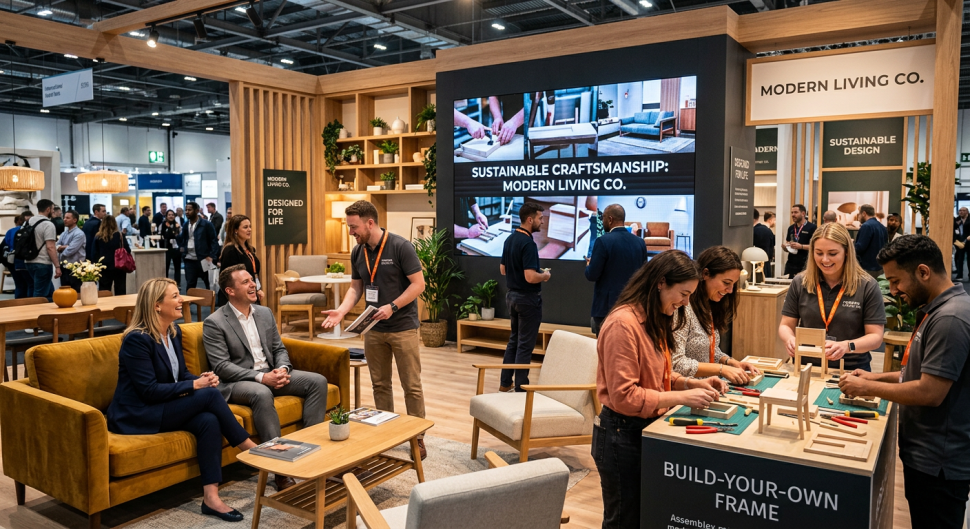
Every year, brands pour six and seven figures into stand builds, activations and experiential spaces – then hand the “real” strategic thinking to the digital team.
I’ve watched this pattern for almost two decades now, and it still baffles me. The channel that puts a brand in front of its most qualified, most attentive, most primed-to-buy audience – face to face, in three dimensions, for hours at a time – gets treated as a production job. A rectangle of space to fill. A backdrop for the “actual” marketing, which apparently lives on a screen.
Meanwhile the digital campaign that ran alongside it, the one with the £40 CPM and the eight-second attention span, gets the strategy deck, the board presentation, the quarterly review.
Something’s backwards here. Let’s talk about it.
The attention economics nobody’s running
Start with the basic maths of attention, because this is where the argument should begin and rarely does.
A paid social ad gets, if you’re lucky, a few seconds of half-focused scroll-past attention from someone who didn’t ask to see it. A trade show visitor who walks onto your stand has already self-selected – they’ve travelled, registered, taken time out of their working day, and physically chosen to stop at your space over every competitor’s. Once they’re there, you don’t have seconds. You have minutes. Sometimes twenty of them.
That’s not a marginally better engagement rate. That’s a different order of magnitude entirely. And yet very few brands cost it that way. Digital budgets get modelled in cost-per-thousand-impressions and cost-per-click, with sophisticated attribution stacks built to justify every pound. Exhibition budgets get modelled in “what did the stand cost” and “how many badges did we scan” – a spend conversation, not a value conversation.
If you actually ran the comparison – cost per minute of genuine, undistracted brand attention – I’d put real money on physical space winning against almost any digital channel you care to name. Nobody’s running that comparison, because the exhibition industry has spent years accepting a seat at the bottom of the budget table instead of building the case for one nearer the top.
Dwell time is a brand metric hiding in plain sight
Here’s a term the events industry throws around constantly and the marketing world barely registers: dwell time.
It’s the single most valuable number generated at any activation, and it’s chronically under-reported outside our own industry. Dwell time isn’t a nice-to-have operational stat for the ops team to note in a wrap report. It’s a direct, physical proxy for engagement depth – the kind of depth that a marketing director would kill for on a landing page or a video ad, and that they almost never get.
Think about what a brand actually learns when a visitor stays at a stand for fifteen minutes instead of ninety seconds. That’s not foot traffic. That’s consideration. That’s a prospect moving through a mini version of the buying journey – curiosity, question-asking, hands-on interaction, conversation with a human – condensed into one physical encounter. No digital format replicates that arc at that speed, because no digital format has a person standing in front of the prospect, reading their reactions and adjusting in real time.
Treated properly, dwell time deserves to sit next to time-on-site and video completion rate in the marketing dashboard. Instead it sits in an events debrief nobody outside the team reads.
Memory is the whole point, and we’ve stopped saying so
There’s a body of long-established thinking in consumer psychology about how multisensory, embodied experiences get encoded into memory more durably than passive viewing does – the basic idea that things we do and experience physically stick harder than things we merely see. You don’t need a research citation to know this is true; you’ve lived it. You remember the product you touched, the demo you took part in, the space you walked through. You do not remember the sixth mid-roll ad you sat through this week, because your brain didn’t need to.
Exhibition design is built entirely out of the ingredients that produce durable memory: physical scale, spatial movement, tactile interaction, live human conversation, sound, sometimes smell. A well-designed stand isn’t decoration around a message – it is the message, delivered in the format your brain is best built to retain.
And yet the industry rarely leads with this. We talk about footfall. We talk about build quality and lighting and “wow factor.” We very rarely walk into a client conversation and say, plainly: this is a memory-creation channel, and here’s the cognitive science reason it will outlast your campaign. We should. It’s a genuinely strong argument and it’s sitting there unused.
A quick thought experiment
Picture two budgets, both around £80k, both aimed at the same audience of procurement and operations directors in a mid-size B2B sector.
Budget one buys a six-week paid social push: sharp creative, decent targeting, a respectable click-through rate by industry standards. It generates a healthy number of impressions, a modest number of landing page visits, and – if the campaign’s well built – a handful of marketing-qualified leads that get handed to sales with varying degrees of enthusiasm.
Budget two buys a considered stand at the sector’s flagship trade show: a space designed around a live product demonstration, staffed by people who actually understand the product, built to hold someone’s attention for ten or fifteen minutes rather than ten or fifteen seconds. It generates far fewer total “impressions” in the loosest sense of the word. But every one of those impressions is a real person, self-selected, standing in front of a human being, asking real questions, for a meaningful stretch of time.
Run those two budgets side by side and ask which one produced more actual pipeline per pound, and in my experience the physical space wins more often than the industry’s own internal narrative admits. It just never gets asked the question, because nobody’s built the framework to compare them fairly.
Why marketing leadership still doesn’t buy it
If the case is this strong, why isn’t experiential sat higher up the strategic pecking order?
Partly it’s measurement. Digital’s entire appeal to a modern CMO is the illusion – and sometimes the reality – of precision. Every click, every conversion, every pound accounted for. Exhibition and activation work has historically measured itself in vanity metrics: footfall, leads scanned, social mentions during the show week. None of that maps cleanly onto the attribution models marketing leadership has been trained to trust, so the channel gets treated as a cost centre with soft, unquantifiable upside, rather than a channel with hard, comparable ROI.
Partly it’s organisational. Experiential often sits with events or brand teams, physically and reportingly separate from the performance marketing function that controls the biggest slice of budget and has the CFO’s ear. The people who understand the strategic power of physical space are rarely the people in the room when channel allocation gets decided.
And partly, honestly, it’s on us. The industry has under-sold itself for years, competing on build cost and turnaround time rather than on strategic outcome. When your own pitch decks talk about square metreage and material finishes before they talk about attention, memory and pipeline impact, you’ve told the client what to value before they’ve even asked.
What proper measurement would actually look like
Fixing this doesn’t require reinventing measurement from scratch. It requires borrowing the discipline digital already has and applying it honestly to physical space.
That means treating dwell time as a primary KPI, not a footnote – tracked, benchmarked against previous shows, and reported the way a marketing team reports session duration. It means separating footfall (vanity) from qualified engagement (value), because a stand that pulls fewer but higher-intent visitors is very often doing its job better than one that pulls a crowd. It means following leads generated at a show through to pipeline and closed revenue with the same rigour a performance team applies to a paid campaign, so the channel can finally be judged on outcome rather than optics. And it means being willing to talk, credibly, about brand recall lift – pairing pre- and post-show brand awareness data with the physical experience delivered, so the memory argument has evidence behind it rather than just conviction.
None of this is exotic. It’s the same rigour that’s been applied to digital for a decade. The exhibition industry just hasn’t demanded it be applied to itself, and clients haven’t known to ask.
The opportunity for anyone paying attention
Here’s the upside in all of this: the brands and agencies who start treating physical experience with the strategic seriousness of a performance channel are going to have a real advantage over the ones still pitching square metreage and finishes.
That means walking into briefing conversations talking about attention economics and dwell time before you talk about materials. It means building measurement frameworks that let a client compare a stand’s performance against their other channels in language their CFO already speaks. And it means, frankly, having more confidence in the argument – because the argument is genuinely strong. Physical space commands attention digital can’t buy, creates memory digital struggles to match, and does it in front of the most self-selected, highest-intent audience most brands ever get in front of.
For agencies like ours, this isn’t just an industry gripe – it’s a positioning opportunity. Most exhibition and activation partners still pitch on build quality, creative concept and delivery reliability, which are all table stakes rather than differentiators. The agencies who start pitching on attention economics, dwell time benchmarking and pipeline attribution are going to look like a different category of partner entirely – one having a strategic conversation the client’s own performance marketing team would recognise and respect, rather than a production conversation happening in a silo down the corridor.
That shift changes who you’re sat across the table from, too. Pitch build quality and you’re negotiating with procurement. Pitch attention, memory and pipeline impact, backed by a measurement framework that holds up to scrutiny, and you’re in the room with the CMO – which is where a channel this powerful should have been sitting all along.
The channel doesn’t have a value problem. It has a storytelling and measurement problem. And those are exactly the kind of problems worth solving before your next stand goes into build.
Don’t keep us a secret. 🍊
Sarah
Director
The Creative Juice